I have always been a great fan and avid user of databases. They’re just so versatile, efficient, easy to use, … I found this to be true for all kinds of data, small and large, high-dimensional and low-dimensional, spatial, temporal, you name it. It was only very recently that my data seemed to have outgrown my PostgreSQL database. Not so much in size, but rather in performance.
Category / Data
Using Tokyo
In the introduction to the UN HABITAT report State of the World’s Cities 2012/2013: Prosperity of Cities it is written:
“As the world moves into the urban age, the dynamism and intense vitality of cities become even more prominent. A fresh future is taking shape, with urban areas around the world becoming not just the dominant form of habitat for humankind, but also the engine-rooms of human development as a whole. This ongoing evolution can be seen as yet another assertion, albeit on a larger scale, of the time-honoured role of cities as centres of prosperity. In the 21st as in much earlier centuries, people congregate in cities to realize aspirations and dreams, fulfil needs and turn ideas into realities.”
(United Nations 2012, v)
I could not agree more, and this is one of the reasons that I was captivated by cities from an early age, long before I started my academic career – or even had an idea of what an academic career is, for that matter. Cities interest me, cities fascinate me, and cities defined me. Having lived in Munich, Frankfurt, and Tokyo, and having visited many other amazing specimen worldwide has definitely had an impact on me and taught me many things. Studying cities is never boring and continues to surprise and astonish me on a regular basis.
GIS & Spatial Analysis – “My” magazine on FlipBoard
I have been maintaining it for quite a while now, but it was only today that I found out that it can also be accessed outside its native app on the web: “my” magazine on FlipBoard.
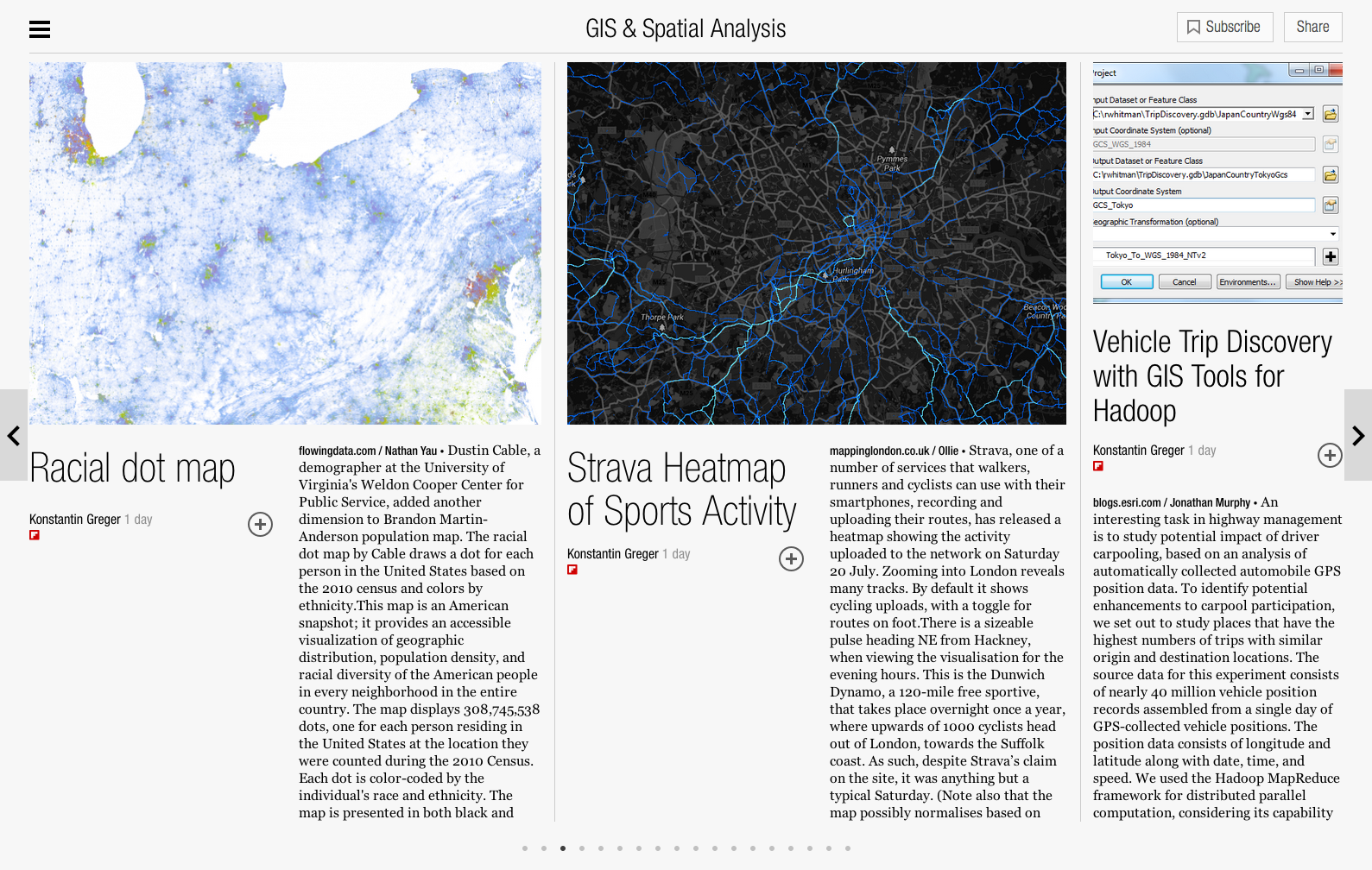
I called it GIS & Spatial Analysis, and that’s exactly what its contents is all about: I “flip” (that’s the FlipBoard lingo for sharing) everything in here I deem interesting and newsworthy from the world of digital maps, spatial data and spatial analysis. Sometimes it’s rather scientific contents, sometimes it’s just interesting or even going to make you smile. If you’re a map and GIS geek like me, that is…
Obviously it’s for free – so go ahead enjoy! The native app is available for iPad, iPhone, Android, Kindle Fire and NOOK – also for free.
IGU2013: Spatio-Temporal Analysis of Bicycle Commuting Behavior in the Greater Tokyo Area Using a Micro-Scale Persontrip Database
I just finished my first presentation of the 2013 IGU Regional Conference in Kyoto. In this presentation, co-authored by my academic advisor Prof. Yuji Murayama from the Division for Spatial Information Science at the University of Tsukuba, I talked about some very early findings of one of our most recent research projects analyzing the use of bicycles in the Tokyo Metropolitan Area. We are especially interested if and how the use of bicycles is integrated in routine commuting activities. We are doing this by analyzing a large-scale database of persontrip information.
Batch-Loading and Merging Shape Files Into PostGIS
Today I was faced with the task of having to load a massive amount of shape files into my PostGIS database. The data in question is the Advanced Digital Road Map Database (ADF) (拡張版全国デジタル道路地図データベース) by Sumitomo Electric System Solutions Co., Ltd. (住友電工システムソリューション株式会社). It contains very detailed information (spatial and attributive) about the road network of all Japan and is thereby quite heavy.
Therefore, it was split into a plethora of files using the following naming schema: mmmmmm_ttt.shp, where mmmmmm represents a six-digit mesh code and ttt represents a 2- to 3-digit thematic code. The mesh code is a result of the data being split spatially into small, rectangular chunks. It follows a simple logic, whereby bigger mesh units (represented by the first four digits) are further subdivided into smaller units (represented by the last two digits). It took only a small amount of time to figure out this naming schema and filter the files that would be necessary for my analysis.
Basically I wanted to merge the shape files into PostGIS tables divided by their topic (i.e. road nodes, road links, additional attribute information, etc.). So I had to find a way to batch import the shape files into PostGIS and merge them at the same time. Yet, since the node IDs were only unique within each mesh unit (i.e. shape file), I also had to find a way to incorporate the mesh codes themselves into the data, so I could later on create my own ID schema for the nodes, based on the mesh code and the original node ID (e.g. mmmmmmnnnnn, where mmmmmm represents a six-digit mesh code and nnnnn represents the original 5-digit node ID).