Using Map Tile Servers in QGIS 2.4

As I explained in a comment on my previous article, the otherwise fantastic OpenLayers plugin is currently not compatible with the freshly released QGIS 2.4 unfortunately. This means two things:

  1. You can’t open any QGS project files that contain a reference to such an OpenLayers base map.
  2. You can’t use it to insert OpenLayers base maps (e.g. OSM, Google, Bing, Stamen, Yahoo, …) into your new map projects anymore.

Continue reading →

The Short Way to QGIS 2.4 Chugiak on MacOS

Today I finally found some breathing room in my projects to dare updating my MacBook Pro (running MacOS X 10.9.4 Mavericks) from QGIS 2.0 (Dufour) to the recently released version 2.4 (Chugiak). Well, to be honest I also realized that I should update to be able to use the QgsFeatureRequest.setFilterExpression() method to make use of filtering expressions (introduced in version 2.2).

The first step was to download the installer images for QGIS 2.4 and GDAL 1.11 from KyngChaos.

The GDAL disk image contains not only the complete GDAL framework (including the GEOS, PROJ, SQLite and UnixImageIO frameworks), but also NumPy. Since version 1.6.2-1 is dated from end of August 2012 I decided to skip installing, since I installed my NumPy later than that and should therefore be up to date already. The GDAL installation worked without a problem.

Next step was the installation of the actual QGIS 2.4. The readme files recommend to delete any existing QGIS.app file from the Applications folder, so that’s what I did. The installer then confronted me with this error message: "QGIS requires the Matplotlib python module (kyngchaos build)."
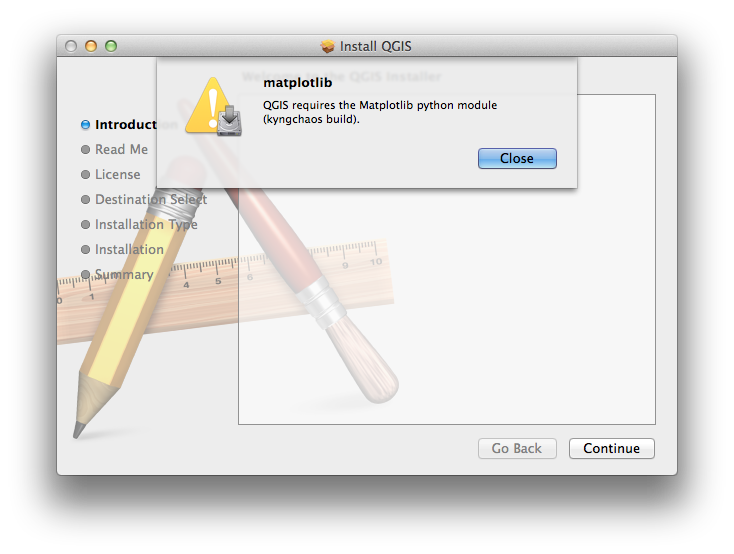
matplotlib python module required

matplotlib python module required

Luckily matplotlib 1.3.1-2 from early 2014 can also be found on the KyngChaos website, so I installed that from the disk image (root authorization necessary) and went back to the QGIS installer. When the installer presented me the readme file once again I realized that I had apparently just read over the hint that not only NumPy but also the matplotlib python module was required – classic user error on my end!

The QGIS installer also requires root authorization, takes few minutes and about half a gigabyte of hard disk space. After the small hickups earlier it finished without a problem, and I was presented first with the beautiful new splash screen and then the GUI itself. Side note: I love the fact that QGIS remembered all my settings regarding toolbars, window locations etc.!
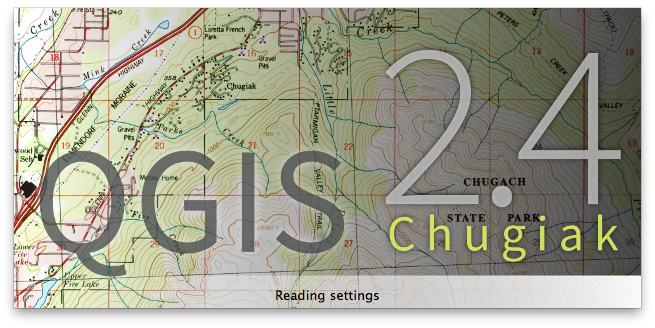
QGIS 2.4 Chugiak splash screen

QGIS 2.4 Chugiak splash screen

QGIS 2.4 GUI fresh after installation

QGIS 2.4 GUI fresh after installation

Huge thanks and props have to go to the team behind QGIS – I can’t wait to look for reasons to try out all the new features. For a quick overview I can recommend Nyall Dawsons blog, whose most recent blog articles provide both an overview of and also some details about what’s new in QGIS 2.4.

Creating Multiple Concentric Ring Buffers in PostGIS

Whenever possible I recently try to get all my GIS work done in QGIS. Most of the time this is no problem at all. Sometimes it makes things even easier, such as when you’re trying to work with your geospatial data in a PostgreSQL/PostGIS database (good luck trying that in ArcGIS!). But sometimes you come across a task that is just so exotic that nobody has ever come across it. Or at least nobody wrote about coming across it…

Continue reading →

Using Tokyo

In the introduction to the UN HABITAT report State of the World’s Cities 2012/2013: Prosperity of Cities it is written:

“As the world moves into the urban age, the dynamism and intense vitality of cities become even more prominent. A fresh future is taking shape, with urban areas around the world becoming not just the dominant form of habitat for humankind, but also the engine-rooms of human development as a whole. This ongoing evolution can be seen as yet another assertion, albeit on a larger scale, of the time-honoured role of cities as centres of prosperity. In the 21st as in much earlier centuries, people congregate in cities to realize aspirations and dreams, fulfil needs and turn ideas into realities.”
(United Nations 2012, v)

I could not agree more, and this is one of the reasons that I was captivated by cities from an early age, long before I started my academic career – or even had an idea of what an academic career is, for that matter. Cities interest me, cities fascinate me, and cities defined me. Having lived in Munich, Frankfurt, and Tokyo, and having visited many other amazing specimen worldwide has definitely had an impact on me and taught me many things. Studying cities is never boring and continues to surprise and astonish me on a regular basis.

Continue reading →

The Times They Are a-Changin’

Back in November I had big plans to use my supposedly growing spare time to write here on my website, but life has told me otherwise. The past five months have been anything but relaxing, even though I postponed the finishing-up of my PhD thesis for that long. The time was filled by extending the research of my thesis by two completely new topics, by working on two publications and by actively participating in three international conferences.

Here’s a quick run-down, since I didn’t even announce the conferences as I normally do:

Publications

  • I successfully submitted a paper to Transactions in GIS, one of the major GIS journals out there:

    Greger, K. (forthcoming). Spatio-Temporal Building Population Estimation for Highly Urbanized Areas Using GIS. Transactions in GIS. Link

    I don’t know yet, when it will be printed, but it’s available as an online early view. I will write a lot more about this in the near future.

  • A concept paper about a research project we recently started at my lab was published in a Japanese publication – the article itself is in English, though:

    Greger, K.; Murayama, Y. (2014). Collection Methods for Spatio-Temporal Personal Movement Data. 平成25年度多目的統計データバンク年報 (Annual Report on the Multi Use Social and Economic Data Bank) Vol.91, 63-83. PDF

  • Also, while it didn’t originate during said timeframe, a book chapter which I co-authored has been published in the meantime:

    Kubo, T.; Yamamoto, T.; Mashita, M.; Hashimoto, M.; Greger, K.; Waldichuk, T.; Matsui, K. (2013). The Relationship Between Community Support and Resident Behavior After the Tohoku Pacific Earthquake: The Case of Hitachi City in Ibaraki Prefecture. In: Neef, A.; Shaw, R. (Eds.) Risks and Conflicts: Local Responses to Natural Disasters. Is: Community, Environment and Disaster Risk Management Vol. 14, 11-42. Emerald Group Publishing Limited. Link

Conferences

  • In November I presented my bicycle commuting research project at the University of Tokyo CSIS Days 2013:

    Greger, K.; Murayama, Y. (2013). Spatio-Temporal Analysis of Bicycle Commuting Behavior in the Greater Tokyo Area Using a Micro-Scale Persontrip Database. 2013年全国共同利用研究発表大会 (Proceedings of the Session of Inter-University Research Activities in Japan “CSIS Days 2013”). Abstract, Poster

  • At the same conference another paper which I co-authored was presented:

    Murayama, Y.; Lwin, K.; Greger, K.; Estoque, R.; Kubo, T. (2013). 位置情報付きのビックデータ(パーソントリップ調査)をWeb-GISでハンドリングする (Handling Big Data with Locational Information (from a Persontrip Survey) using Web-GIS.) Presented at the Session of Inter-University Research Activities in Japan “CSIS Days 2013” on Nov 22. Kashiwa, Japan. (Japanese) Abstract

  • I mentioned in a brief announcement that I would also join the 2014 Annual Meeting of the AAG:

    Greger, K.; Murayama Y. (2014). Spatio-Temporal Analysis of Bicycle Commuting Behavior in the Greater Tokyo Area Using a Micro-Scale Persontrip Database. Presented at the 2014 Association of American Geographers’ Annual Meeting on Apr 9. Tampa, FL. Abstract

  • One week ago I presented the bicycle project at the 2014 Meeting of the Japan Geoscience Union (JpGU):

    Greger, K.; Murayama Y. (2014). Spatio-Temporal Analysis of Bicycle Commuting Behavior in the Greater Tokyo Area Using a Micro-Scale Persontrip Database. Presented at the 2014 Japan Geoscience Union (JpGU, 日本地球惑星科学連合) Meeting on April 28. Yokohama, Japan. Abstract

  • Lastly, another paper which I co-authored was presented at the JpGU Meeting:

    Murayama, Y.; Lwin, K.; Greger, K.; Estoque, R.; Kubo, T. (2014). 非集計パーソントリップデータをWeb-GISでハンドリングする(Handling Non-Aggregated Person Trip Data with Web-GIS.) Presented at the 2014 Japan Geoscience Union (JpGU, 日本地球惑星科学連合) Meeting on April 28. Yokohama, Japan. (Japanese) Abstract

That’s all nice and fine, but the most important thing is was the work on my PhD thesis. I’m very proud to be able to announce hereby that the work is done! In addition I also successfully defended the dissertation in late April. Now all that’s left for me to do is to present the thesis contents one final time to a public audience (this will happen on May 9, 2014 – but, I don’t know the details yet) and make the thesis itself ready for press.

I’m aware that this sounds like a copy & paste from said article in November, but I’m very positive that from now on my duties should leave enough time to finally write more contents here on the website. There’s so much I want to write about! A non-comprehensive list:

  • A general introduction of my PhD research and thesis contents.
  • An introduction of the novel methodologies I developed in the course of my dissertation. One of them is the topic of the aforementioned article in Transactions in GIS, and I’m planning on publishing a few others in journals as well.
  • Some contents about terrorism in Japan. This is also part of my PhD research, but I have a publication about this topic in mind as well.
  • More details about the bicycle project and the progress it has made over the past months.
  • An introduction about the hybrid movement data collection process I introduced in the second publication mentioned above.
  • An introduction of a new research project we have recently started at my lab (the academic year in Japan starts in April). This involves a lot of data analysis, so there should be some interesting applied contents here.
  • A number of other applied topics that came up during either my PhD research or one of the other research projects I’m involved in…

So please stay tuned and expect the contents of this website to expand seriously in the near future!